
The ability to quickly and easily connect to the Internet, make safe and convenient payments at any time, even to call just about anyone on a mobile phone are all acts that millions of Africans take for granted in 2026.
But just 17 years ago, most of these actions were impossible, and unthinkable for most of the continent.
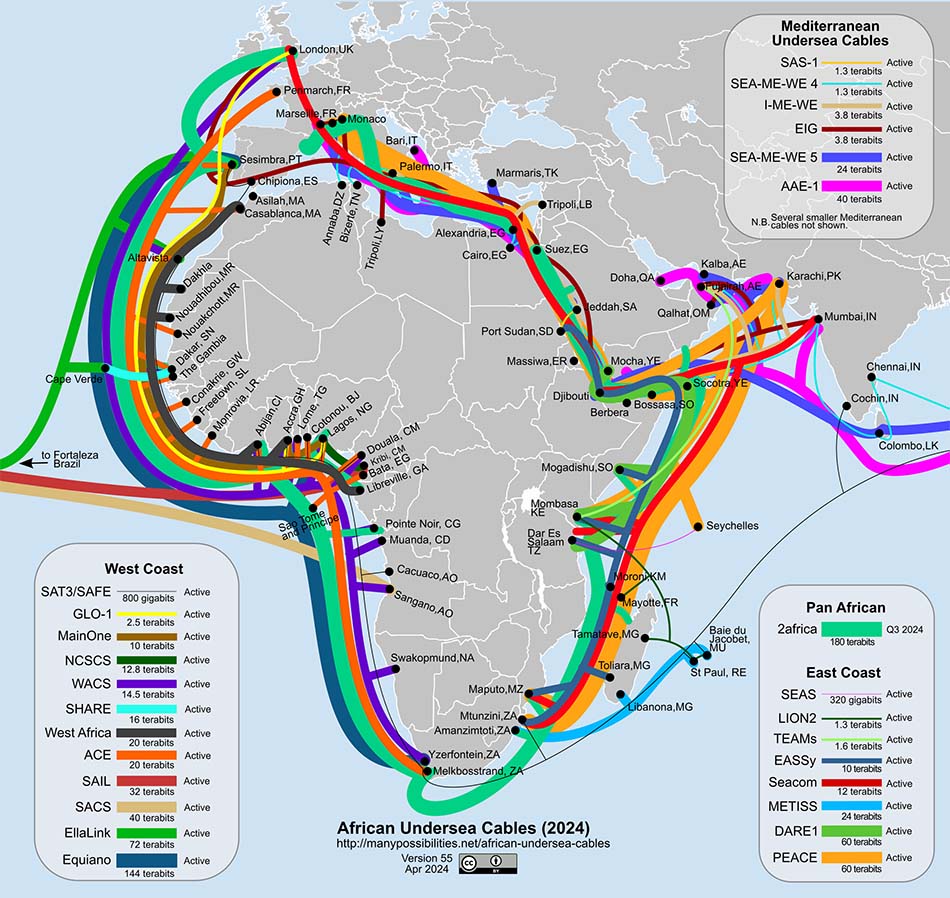
African undersea cables
Credit: Steve Song – https://www.flickr.com/photos/ssong/53664983994
Undersea cables
Prior to 2009, the continent was connected to the rest of the world by just three slow undersea cables: SAT-2 connecting South Africa to Portugal; SAT-3, linking South Africa and West African countries to Spain and Portugal; and SAFE (South Africa Far East) cable connecting South Africa to Malaysia.
Satellite communications were available, but these were slow and, for most users, prohibitively expensive.
In 2009, everything changed: the fast privately-funded Seacom undersea cable, running down the east coast of Africa, literally opened Africa to the world.
Seventeen years later, more than 70 undersea cables land in Africa, with 37 of 38 coastal nations having at least one landing point.
Regional hubs in Egypt, South Africa, Djibouti, Nigeria and Kenya have the highest concentration of cable landings.
Fibre networks
Bringing connectivity from the coastal landing points to users across the continent is a mammoth undertaking which has been largely accomplished by the rollout of almost 1,5-million kilometers of terrestrial fibre optic cable.
This massive network includes about 324 730 km of metropolitan fibre rings and fibre-to-the-home/building (FTTH/B) networks.
At least half of these networks have been developed by the mobile telecommunications operators -built out as backbone networks. About 40% are publicly owned.
Data centres
Digital transformation is predicated on the availability of data centres. The need for processing power is exacerbated by the introduction of artificial intelligence (AI), which consumes vast compute resources.
Africa presents some pressing challenges when it comes to data centre development including vast distances, network availability, and issues relating to power and cooling.
Notwithstanding these challenges, there are more than 240 data centres on the continent. However, despite the rapid build-out, the continent’s data centres still account for just 1% of the world’s capacity.
The infrastructure is clustered mainly in South Africa (about 60 data centres), Nigeria (22 data centres), Kenya (20 data centres) and Egypt (18 data centres). Smaller-scale infrastructure is also being developed in markets including Morocco, Tanzania, Mauritius, Angola, Ghana, and Senegal.
With the roll-out of data centres, global hyperscalers like Microsoft Azure, Amazon Web Servicce, Google Cloud and Oracle have all opened cloud regions. Home-grown cloud providers also offer services across the continent.