
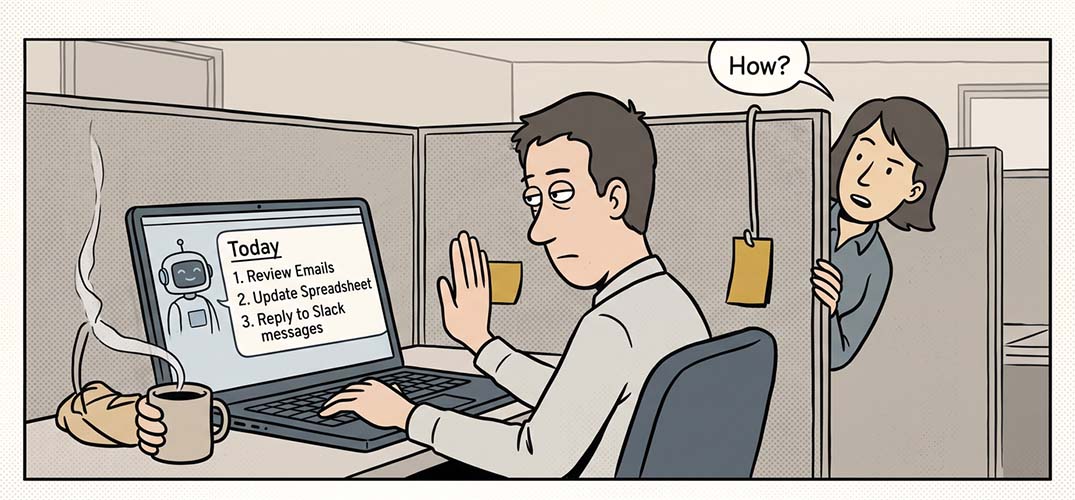
By Barry Buck – You know the mug. White, slightly chipped, lives on every second desk on Earth: “Don’t talk to me until I’ve had my coffee.” A small, socially-sanctioned warning that the human is not yet operational and should not be approached with anything resembling a decision.
I want to argue the mug is now obsolete — not because we’ve stopped needing the warning, but because coffee is no longer the thing that boots us up in the morning. For a growing number of us, the first prompt of the day is.
Stay with me, because there’s a real practice under the joke, and I think it’s the missing piece of the entire AI-in-business story.
The rocket and the parking space
Your company almost certainly bought everyone an AI assistant this year. There was a launch, there were slides, and somewhere on one of them sat the phrase “transformative productivity” — which became a KPI in your objectives that nobody quite knows how to satisfy. Then the webinar ended, everyone went back to their desks, and we collectively pointed the most powerful technology of our lifetimes at turning a spreadsheet into a bar chart and making an email sound less annoyed.
That’s not a failure of the people. It’s a failure of the handover. We were given a rocket and a parking space.
The tools are extraordinary — I build on them daily, and they’ve changed what one person can do. But a tool is not a method, and capability is not a process. “Here’s Copilot, here’s your target” isn’t a playbook; it’s a dare. And here’s my small, affectionate dig at the vendors: they spent a decade distilling these models, and couldn’t spare a fortnight distilling how to use them. Everyone got the sword. Nobody got the manual.
So we wrote one. By accident.
The thing we found while building something else
For months my team has been building the AI-first rebuild of our product, Roboteur — the preview we call the Hero Factory. Small team, real deadlines, every one of us working shoulder-to-shoulder with Claude.
Somewhere in the middle of it, we noticed that the way we’d organised ourselves around the AI had quietly become as valuable as the software we were shipping. We didn’t design it on a whiteboard; it emerged from the friction of doing the work — and it has almost nothing to do with writing code, which is exactly why it belongs in an issue about adoption rather than a developer forum.
This isn’t theory from the cheap seats. The same approach underpins automation running in production at a major South African bank: north of R80 million in measured value, more than 9 000 automated actions a month, sixteen industry awards. We know the tools work. What kept me up was why so few people get that kind of return from the same tools on their own desks. The answer was the playbook.
The Navigator and the kick-off
It comes down to two ideas and one role that isn’t on your org chart.
The first is the Navigator: one person — think product owner, team lead and department head fused into one — whose job isn’t to run a meeting but to make the morning’s decisions. Instead of a standup where six people report status up a board, the Navigator reads a debrief the AI has already assembled, decides what matters today, splits the work into lanes that won’t collide, and defines what “done” looks like for each. Direction down, not status up.
The second is the kick-off prompt — the artifact at the centre of everything, and almost insultingly simple. Each person starts the day not by staring at a board wondering where to begin, but by pasting a short, decided block from the Navigator into their own AI: the exact task, what they own, what they must not touch, and the two or three checks that mean it’s finished. Paste, go.
If you’ve sat in a standup, you’ll feel the inversion. The standup extracts status upward — everyone takes a turn proving they did things. The kick-off does the reverse: it hands each person an already-decided starting point downward, and a shared written record carries the status the meeting used to squeeze out. The board stops being a meeting you attend and becomes a record that’s simply true.
And it doesn’t box people in — it sets them loose. One of my developers, freed from the daily “where do I start” tax, now finishes her assigned track by lunch and goes hunting in the next. Remove the friction at the start of the day and your strongest people don’t coast; they run.
This isn’t a developer trick
Here’s where it leaves my world and enters yours. Picture a fraud analyst at a bank. Every morning the job is the same: pull the day’s chargebacks, enrich each from four internal systems, assemble the spreadsheet the rest of the process depends on. Except it never goes like that. A query lands. A system misbehaves. There’s a “quick call” about the misbehaving system. By eleven, the actual deliverable hasn’t been started.
Now run that desk the new way. The repetitive compile is the agent’s job, kicked off by a one-line prompt and guided by the analyst. The diversions — the emails, the “can you also just pull…” requests, the investigations that derail the day — get caught and queued by the agent instead of detonating in the human’s lap. The analyst’s day becomes the part that was always the point: chasing the fault with the team, deciding what the anomalies actually mean. The labour goes to the agent; the human goes to the judgment; and the work that moves the business happens faster than budgeted, because it’s no longer fighting the busywork for the same eight hours.
Same shape as before: a Navigator handing down decided work, each person’s agent acting as both their assistant and a node in the Navigator’s plan, the repetitive load automated, the human freed to collaborate. Your Copilot or Claude licences can already do most of this. What’s missing has never been the tool. It’s the choreography.
How to write your own playbook
You don’t need our product to start — you need the operating model. The high-level recipe, tool-agnostic:
- Appoint a Navigator. One person sets direction, draws the lanes, defines “done.” They route work down, not collect status up.
- Write a daily kick-off prompt per person. Short and decisive: the task, the lane, the “do not touch”, and the checks that mean it’s done.
- Give the AI a shared memory. A couple of living documents — what we’re working on, the known gotchas, where things stand — that every AI session reads, so nobody re-explains context each morning.
- Cut non-colliding lanes. Split work by area with explicit boundaries, so people and their agents run in parallel without standing on each other.
- Integrate continuously. Merge and check daily, not at the end, so problems stay small and “good” is always close.
- Keep an insights trail. End each day with a short note of what shipped and what to watch — over time, the data that improves the method, and quietly does the job the standup pretended to.
None of it is exotic. All of it is the difference between owning an AI assistant and running on one.
The recipe book
This is the Hero Factory pointed inward: one Navigator and a handful of AI-augmented people holding what used to need a department — less ceremony, better mornings. We’re previewing it inside the AI-first Roboteur, but I’ve come to believe the operating model isn’t ours to hoard. It fell out of running a real team under real pressure, it generalises well beyond our stack, and almost every business that bought a licence this year is sitting on the tooling and missing only the method.
So that’s what we want to write next: a proper recipe book any team can pick up, whether you’re on Claude or Copilot. Not “buy our thing” — a way of working.
Don’t talk to me until I’ve run my prompt
The mug had it backwards. The point was never to be left alone until the caffeine catches up. It’s to sit down already knowing exactly what today is — handed to you, decided, the busywork already moving before you’ve taken the lid off the cup.
Keep the coffee; it’s still good. But don’t talk to me until I’ve run my prompt.
Barry Buck is the chief technology officer of Saucecode and Roboteur architect
 www.saucecode.tech