
By Barry Buck – Last time I wrote for Channelwise, I joked about asking Claude to help me write the article.
Well, this time the irony has compound interest: the AI I used to write that piece has since triggered a market panic that wiped nearly a trillion dollars off software stocks worldwide. My co-writer went and broke the economy.
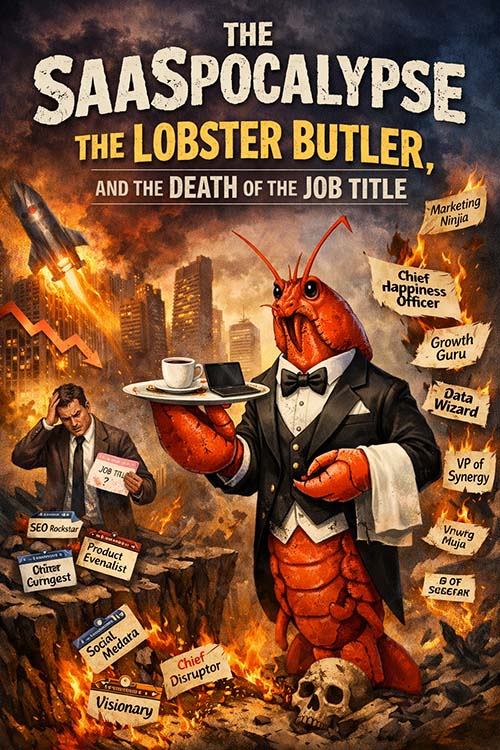 Two months later, my December piece already reads like a dispatch from a gentler era. Back then I was worried about vibe coders and emoji-laden bullet points. Now I’m watching the entire SaaS industry scramble to justify its existence while a lobster-themed AI butler exposes 30 000 people’s private data to the open internet.
The SaaSpocalypse
In early 2026, Anthropic released Opus 4.6 alongside Claude Cowork – a suite of plugins that let AI agents handle complex professional workflows autonomously. Legal research, CRM management, data analysis, marketing automation – tasks that entire SaaS companies were built to solve, now executable by a single agent from raw inputs. This is not incremental improvement. This is a phase transition.
Within days, nearly $300-billion in tech market value evaporated. Thomson Reuters fell 16%. Salesforce, ServiceNow, and Adobe shed 6% to 8%. By the time dust settled, software stocks had lost around $830 billion in six trading days. Nvidia’s Jensen Huang called it “illogical”. Arm’s CEO called it “micro-hysteria”.
I respectfully disagree. Not because software companies will vanish overnight – they won’t. But the market finally priced in something those of us in the automation trenches have known: the value of most SaaS platforms isn’t their code. It’s the structured workflow they impose on messy human processes.
AI agents can now impose that structure dynamically, in real time, customised to exactly your need. Why pay per seat for a CRM when an agent can build you a bespoke workflow on the fly?
I can now spin up a functional clone of practically any major SaaS product using Claude Code with Star Trek replicator-level ease. The barrier to entry hasn’t just lowered; it’s been removed.
The Lobster Butler
If the SaaSpocalypse is AI replacing software, then OpenClaw is AI replacing you – and doing a terrible job of locking the doors. OpenClaw (formerly Moltbot, formerly Clawdbot) is an open-source AI agent that follows you across WhatsApp, Telegram, Slack and Teams with direct access to your data, devices, and services. It went from weekend hack to 100 000 GitHub stars in weeks. The fastest-growing open-source project in memory.
It’s also a security nightmare. Bitsight found over 30 000 exposed instances on the public internet. Authentication accepts a single character as a valid password. Honeypot servers attracted attackers within minutes. Researchers demonstrated you could simply ask the butler to dump API keys and execute arbitrary commands. It obliged cheerfully. Major Korean tech firms – Kakao, Naver, Karrot – banned it from corporate networks. China’s industry ministry issued warnings.
Here’s what frustrates me: personal AI assistants outside the office aren’t that useful. Booking dinner? Scrolling TikTok? Solutions looking for problems. But inside an organisation – where I spend every day consulting and building automation solutions on Roboteur – the value is massive. Document intelligence, compliance workflows, data reconciliation: exactly where AI agents deliver transformative ROI.
Yet the security risks OpenClaw demonstrated are precisely what makes enterprise IT break out in hives. Individuals hand their AI butler the keys with zero security, while enterprises that could actually benefit are stuck drafting AI usage policies that’ll be obsolete before the ink dries.
The collapse of the job title
Which brings me to the question I can’t stop thinking about: is white-collar skilled work – analyst work, knowledge work, coding, research – collapsing into a single role? Is the future job title simply “person who instructs and manages swarms of AI agents”?
I think yes, and it’s already happening. In a single day I now move between writing automation solutions, reviewing AI-generated code, drafting legal documents, analysing reconciliation data, and writing this article – all with AI agents as my primary workforce.
The boundaries between developer, analyst, project manager, and content creator have dissolved. What remains is the ability to decompose problems, craft precise instructions, evaluate outputs, and orchestrate agents toward a coherent goal. This is context engineering. This is the new core competency, and it doesn’t care what your degree says.
Two months ago I ended with “Can’t fight it. Might as well spawn another agent”. That was cheeky. Now it reads like a survival strategy.
Might as well spawn another swarm.
 About Roboteur
Saucecode built Roboteur to break down the barriers typically associated with enterprise automation. Our hyper-automation platform combines full-suite RPA with a scalable real-time datastore, automatic API generation, and visual development in Roboteur Studio. With accessible pricing and comprehensive capability, it’s a platform that scales as your needs evolve.
Barry Buck is the chief technology officer of Saucecode and Roboteur architect
www.saucecode.tech